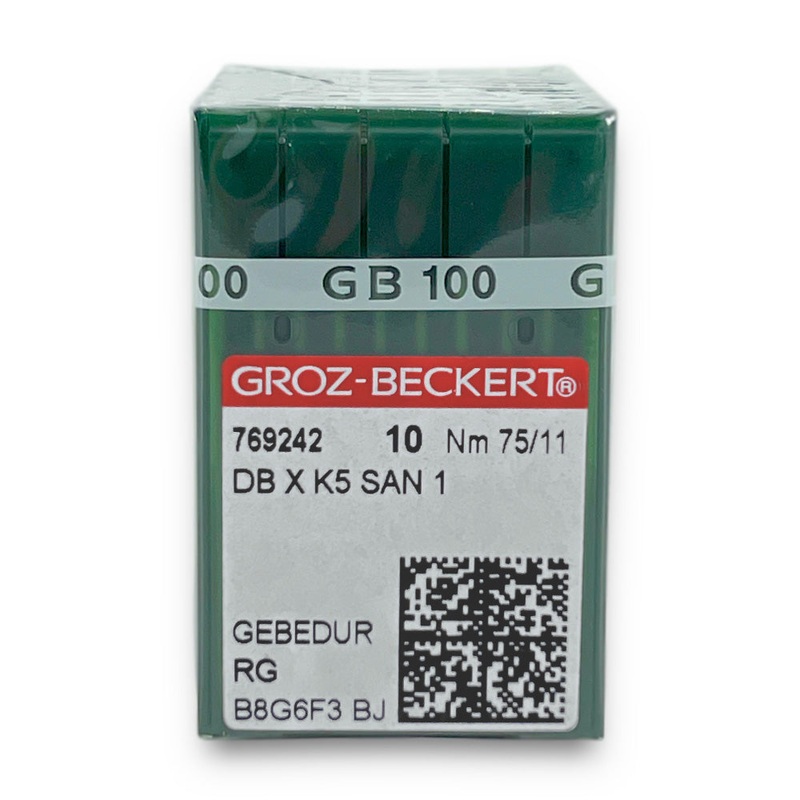
Groz-Beckert DBXK5 SAN1, with its special design and a titanium nitride coating, offers highest stability and maximum resistance against wear. They are highly recommended when embroidering thick or very sturdy materials, such as leather or caps. These needles feature a titanium nitride coating, which is 2.5 times harder than steel. This greatly improves needle stability and reduces needle deflection and breakage.
DBXK5 SAN1 Needles are suitable not only for embroidery automats. It is specially adjusted (SAN1). In addition the GEBEDUR type increases the needle life span up to 3 times compared to classical chromium needles.
Needle Diagram:
- Shank-The shank extends from the butt to the cone. Most needle systems have the same shank diameter for all sizes. In the sewing machine, the shank enters into the needle bar (hole or clamp) where it is usually fixed by a screw.
- Cone– The cone is the transition from shank to blade. The length of the cone depends on the ratio shank diameter to blade diameter as well as on the angle or radius of the cone.
- Blade-The blade is the part of the needle between the end of the cone and the beginning of the eye.
-
Long Groove (At the back of the needle)– The long groove runs from the end of the shank to the beginning of the eye. It always faces the threading direction and, in most cases, is of the same width as the eye. When the needle penetrates the material or when the loop is enlarged by the looper/hook, the long groove protects the thread from severe frictional contact with the material.
-
Scarf-The scarf is a recess in the needle blade, which permits the unobstructed movement of the looper/hook and a reliable catching of the loop.
-
Eye-The eye is the opening in the needle blade through which the thread is inserted.
-
Point– The point extends from the beginning of the eye to the end of the needle.


Reviews
There are no reviews yet.